Miyerkules, Nobyembre 30, 2016

Muted Group


From what I understood, the Muted Group theory is considered to be a critical theory because of the involvement of power; and how it is used against people. The theory is said to be concerned with different groups of people who are said to be powerless compared to others. British anthropologists, Edwin Ardener and Shirley Ardener, were the first two people who introduced and developed the theory. The theory focuses on the ways that the communication practices of dominant groups suppress, mute, or devalue the words, ideas, and discourses of subordinate groups. Edwin contributed to anthropology by studying genders and concluded that many ethnographers in the society were generalized to the male population, which led to the creation of the theory. The theory explains the cause of muteness by a certain group of population especially of that of women in the society. The theory upholds a gender perspective where the male is the dominant class.

University of North Carolina Wilmington and University of Southern California researched on the theory in the context of media, and the role it plays in influencing people to give into the idea of a male dominated society. The schools researched to see how the media portrays women in the context of movies. One movie that was examined was Legally Blonde, and was said to be the perfect example of the theory. It was considered to be perfect because it showed women trying to step in to the world of law, an attitude carried by much of society as a male dominated career. Also in the movie, it was shown that legal skills were only for men, and she only knew about hair care, which in our society, women are believed to be only good at that aspect.

Second, this theory is not only limited to gender, but also power difference and one-group under-represented compared to the other. It is seen in the movie The Help, a movie about a time in America where white American women dominated black women. In the movie, Black women's perception towards things are greatly rejected by the White society. This shows how the different cultures are and how the other, showing how they dominate in the society, mutes one. It shows how this Black women are a muted group having to be overshadowed by all the White women.


         The third example would be the ever present stereotyping of women as a sex symbol in the advertisement, especially in male products. The perspective of male towards women has been narrowed down to either sexual or emotional symbol. One perfect example would be this Dolce and Gabbana advertisement. The ad portrays men in a powerful dominant manner, standing over the women who look weak and powerless to the grasp the man has on her. Another example of the image of women as sex symbol in the media would be the Fifty Shades of Grey trilogy. In the book, Anastasia, the main female character, is convinced and obliged to pleasure the male.


The muted group theory was further studied by Cheris kramarae, a professor in women studies upheld the idea that, communication was started by men and due to that reason they take advantage of women. While speaking, women are considered less powerful than men and the reason behind this is simple psychology. Women’s needs are emotionally driven unlike men. And thus the perspective of women differs from men in all aspects. As women now become powerful and equally contribute to her family and through awareness, the perception dominance can be changed. Women are growing to be more independent. More and more examples are occurring in the media. Starting with famous Disney movies such as Mulan, Brave, and Tangled, talk shows like Ellen and Oprah, and even female politicians and presidential candidates. Women are now part of the workforce where they can take on different leadership roles.

Cultivation Theory


From what I understood, Cultivation Theory or cultivation hypothesis, cultivation analysis, is a process by which television shapes beliefs about social reality. The theory was proposed by George Gerbner, and its core theory is the effect of media. Gerbner wanted to know if watching television heavily influences the perception of people, and if it did, he wanted to know how as well. The theory states that the people who watch television more frequently are most likely to be influences by the messages given from television. The influence goes to such an extent that their world view and perceptions start reflecting what they repeatedly see and hear on television. Television is, therefore, considered to contribute independently to the way people perceive social reality. The theory suggests that television and media possess a small but significant influence on the attitudes and beliefs of society about society. Those who absorb more media are those we are more influenced.

One perfect example of the theory is the violence. The cultivation theory has been widely used in the study of violence in television. According to research, the theory has been used to explain the behavior of people who watch either violent cartoon shows, movies and video games become violent themselves. Repeated exposure to violence on television emphasizes the beliefs that the world is a dangerous and unsafe place to live in. It also said that repeated exposure of violence on television stresses that the acts of violence are considered to be a natural response in times of conflict. “Put simply, cultivation theory posits that the amount of violent TV we watch directly correlates with how paranoid we are. It also states that we watch more violent TV than we realize. Rest assured, there are other parts of the theory, but that brief summation should suffice for this discussion.” Said by Blogger Clint Graves.

Another example of cultivation theory is the alcohol consumption seen on television. Researchers Beullens, Roe, and Van de Bulck conducted research relating to alcohol consumption in music videos. The research revealed that high exposure to music videos develops an unrealistic perception of alcohol consumption. Musicians in these videos endorse alcohol in their songs and create a false reality about alcohol and its effects."  People develop expectancies through an interpretation process that is both logical and emotional, making use of both real-life and televised sources of information. The researchers argued that an effective strategy for the prevention of alcohol abuse must help children develop skepticism toward televised portrayals of alcohol use and must address the primary role played by parents as information sources and as behavioral models.

Lastly, my example would be the views of the audience on the LGBT community. A study was conducted and it found that there was an extremely high level of sexual activity in comparison to the amount of gays that appeared on television. This has led those who are heavy television consumers to believe that the gay community is extremely sexual. Much like the idea of a mean and scary world it gives people a parallel idea of an extremely sexual gay community.  A content analysis of 98 primetime entertainment programs on network and cable television examined what types of gay relationships are being presented and whether characters offered opinions on gays and gay marriage. An Internet survey based on cultivation theory then looked for relationships between television viewing and attitudes toward gays and gay marriage.

Agenda Setting


The Agenda Setting theory, also known as the The Agenda Setting Function of the Mass Media, was a theory coined by Maxwell McCombs and Donald Shaw in 1972. According to the two doctors, the news play an integral part in the shaping of political realities. When the media reflect on the views of a candidate during a campaign, they are also shaping and determining the issues of importance. The theory describes that the media is very influential, for it tells people important issues. The two investigated the theory through the 1968, 1972 and 1978 elections; and after thorough investigations, they focused on two elements: awareness and information. They tried to assess the relationship between what voters in one community said were important issues versus the actual content of the media messages used during the campaign. This theory is intended to apply to the news media, although in certain cases it has been applied to other areas of the media and messages which they transmit to audiences. Media coverage not only directs what people think, but also shapes how people think.

            One perfect example of agenda setting is one of the candidates in the US Presidential Elections right now, named Donald Trump. Right now, the media is very focused on the upcoming primary elections.  CNN and ABC’s headlines are all about the democratic debate, and it is seen that the news channels focus more on the republicans, rather than the democrats. The media is telling to the viewers, readers, and voters that the primary election is the most important thing happening in the world. In this case, voters are actually learning quite a bit about politicians; however, there still isn't much in the way of actual substance on the issues.  Stories are focused on who "won" the Democratic debate and whether or not Donald Trump is "the best" or not.  While these stories certainly introduce voters to the candidates, voters still don't get much substance that will help them in deciding who to vote for, based on policies or issues.

            Another example would be Kim Kardashian’s rise to fame. The lives of celebrities are monitored and broadcasted to the public.  With the creation of the Kardashian’s “reality” shows, along with the strong media presence of every Kardashian sibling in tabloid magazines and product lines, the media is telling us what to think about. Kim Kardashian, along with her sisters and brothers, has been said to have no talent all. All thanks to Kim’s sex tape with a semi-famous rapper, the Armenian, talent-less woman has made her way to Hollywood.  From then on, the tabloids fallowed her constantly and pictures of her were on every magazine. Soon, they had created a business empire and numerous products that hold the Kardashian name. This emphasized media is creating more interest among weak viewers, who allow the media to shape what they think about. Sad.


            And lastly, the media coverage of the video the class just watched, regarding the scandal of former United States President Bill Clinton and his affair with his secretary, Monica Lewinsky. According to Ivana Segvic, “The "sex scandal/adultery" attribute was used most often, was of low relevance, and we speculate that because of its high use in the beginning, persisted in people's minds, influencing the way they viewed continuing coverage of the scandal.” . Finally, ramifications of Clinton/Lewinsky coverage on the 2000 presidential election are discussed. According to Segvic, the 2000 presidential election was a sensational story that captured the attention of the world. It was remembered as one of the closest, most suspenseful, and unpredictable elections in U.S. history. In light of the poll results demonstrating the importance of a presidential candidate's morality and character, one wonders about the public's disinterest in and dissatisfaction with the overwhelming earlier media coverage of the relationship between President Bill Clinton and Monica Lewinsky, and the Gore campaign decision to distance itself from Clinton.                                                                     

Semiotics


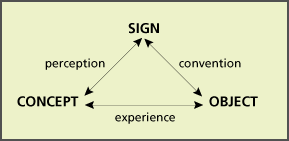
            Semiotics, or also known as Semiology, is the study of signs, symbols and its signification. It does not only refer to the ‘visual signs’ that we see everyday such as road signs and bathroom signs, but it also includes words, sounds, and even body language. The theory is also studied in art, literature, mass media, education, computer and biology. Semiotics is associated with the work of the American philosopher, Charles Sanders Peirce and semiology with the work of the Swiss linguist and semiotician, Ferdinand de Saussure. Both are concerned with how meaning is generated and communicated. According to Peirce, semiotics means “something which stands to somebody for something in respect or capacity” and even categorized it into three parts: the symbol, icon and the index. While Saussure defined semiotics as the “sign is the whole that results from the association of the signifier and the signified”.

 A perfect example of Semiotics would be the cave paintings made by human beings in the past. It is said that humans have been making cave paintings or symbols for almost 10,000 years. The cave paintings show that people in the pre-historic times had a sense of self-image and self-importance, and communicate abstract concepts. It gave people a way to see something that otherwise, we would not know about today. Another example is the ancient Vedic traditions used visual tools to serve as centering devices and as symbolic compositions of energy patterns, which were then adopted for worship and meditation.


It is said that Semiotics is the keystone of brand building; since branding is one of the critical sites on the battlefield of meaning. Through the actions of signs, brands accomplish a perpetual presence in the consumers; both leave a mental representation and emotional connection. Brands become a symbol trigger in the memories of a consumer’s brain. Take for example the brand, Nike and it’s famous logo, the swoosh. The swoosh is now one of the most recognized brand logos in the world. According to Naomi Klein author of the book “No Logo” she mentions that the swoosh is “worshipped as art and a heroic symbol – it defines athleticism, courage, honor, victory, teamwork and all other aspects correlated with sports.” The Nike swoosh has been made into this cultural dissemination that stands for athleticism, power, fitness, and all other aspects Nike attempts to incorporate into their brand image. If any company can translate the importance of creating, protecting, and maintaining a brand for a company, Nike is the perfect example.  All thanks to their swoosh. Another visual example of semiotics is the road signs that people see and often times don’t follow. Following Peirce’s categorization, the icon, a pictorial representation of something.  For example is a sign that says “No smoking”, which conveys clear message that people should not smoke in this place. In this sign, a picture of a cigarette is shown and a crossed red line. For the second category, the index, where there is a direct link or connection between the sign and object, the perfect example of that would be the traffic signs. Traffic signs like “No U Turn and No right on red” state the obvious. Though often neglected, traffic signs are placed in different areas to ensure the safety of drivers. And lastly, the symbol that is defined as no logical meaning between it the object or may have various meanings and interpretations to people. An example of symbol would be the drawing of a heart, which often connoted as a symbol of love. The shape of heart is only assumed to be the sign of love and has become a symbol in the society during ages. So, the shape of heart always is used to strengthen relationships and passion. The heart shape may convey a lot of massages that all of them are related to love at the end.


One non-verbal example of semiotics is body language. Though often misunderstood and misinterpreted, body language can sometimes send signals stronger than words. Body language often has great impact in transmitting messages to the listener. For instance people do not tell each other that easily how they feel about each other, or how the words of a message need to be interpreted. To make the meaning of the words clear, body language comes in.

Mediamorphosis


Mediamorphosis is a term made up by Roger Fidler. He wrote a book called Mediamorphosis: Understanding the New Media, and in the book he defines Mediamorphosis as “a unified way of thinking about the technological evolution of communication media. By studying the communications system as a whole, we will see that new media do not arise spontaneously and independently — they emerge gradually from the metamorphosis”. He states that technology evolves. He also states that the same forces that shaped our past are the same forces shaping our future. Technology will continue to advance overtime and will continue to make people’s lives easier. Humans make new innovations to cater the needs and wants of other people. There is no determination of the death or end of media, for newer forms of media emerge, thus the older forms do not die, but eventually adapt and evolve to time. The theory states that the  media, technology and communication are all in connected. Fidler says tates that we have to see all communication methods as one in order to understand them properly. 


One example of a product of mediamorphosis is the car. Cars provide means of transportation, and it also can be an indication of a person’s social status. Cars are considered a necessity. As early as 4000 BC to 3000 BC, humans have learned to use  donkeys, camels, and horses for transportation. And in a few years later, the wheel was  invented, and in the year 1886, thanks to Karl Benz, one of the first engineers to invent the first automobile. To this day, car designers come up with new ideas to make human beings’ to have better experiences with automobiles. Recently, Google invented the self-driving car. According to Google, the sophisticated operating system that guides the cars makes them safer than if a human driver were behind the wheel. The vast majority of car accidents are caused by human error. Self-driving cars an also travel closer together, which would cut down on traffic congestion.

Another example of mediamorphosis is the computer. In the current world, it’s almost impossible to imagine that someone can live without computers. Computers have become an electronic device of almost every day use for individuals of every age. Computers have gained significance as they have improved the efficiency and productivity of work done. Back in the day, the computer used to take up the space of one whole room. Now, it can be as tiny as the palm of people’s hands. Since people demanded portability throughout the years, designers have successfully thought of ways to make the computer as small as possible. To this day, computer designers still think of ways to advance the technology of the computer.

Another example is storage. Thanks to company IBM, the evolution of external storage would not be possible today. IBM created the first 8-inch disk, or they called “memory disk”, having a memory of 80 kilobytes. The original disk was bare, but dirt became a serious problem so they enclosed it in a plastic envelope lined with fabric that would remove dust particles. Years later, the smaller floppy disks were invented, as well as the CDs, DVDs, External Hard drives, USBs and SD Cards; with increasing storage space. The highest storage recorded for the external hard drive today is a massive 5 terabyte memory. Now, there is a thing called cloud storage, which enables files to be stored wirelessly.

According to Kevin Kelly, he describes a never ending chain of solutions to problems that create still newer problems. And that’s what drives demand for technology and why, on balance, it’s a good thing – it solves our problems.  As long as we have a needs unmet, progress will go on. Technologies wants are born out of our own desires. The development of new technology helps people save lives; it helps people make work easier and makes the world a better place to live in.

Technological Determinism


Technological Determinism, also known as Medium Theory, is a theory that states that technology is the agent of social change. Technology is the force behind the development of society and our culture. The theory explains the relationship between technology and society. It also explains that society will always be affected by the technology. According to Jennifer Slack and J. McGregor Wise’s book “Culture & Technology: A Primer”, the authors explain technology as the central consideration in the development of modern culture. They also point out that technology plays the central role of cultural change. Langdon Winner also describes technological determinism as the belief that technological change is the single most important source of change in a society. 

Technology is important in today's world because it serves a variety of functions in many of the most important aspects of modern society, like education, communication, business and scientific progress. A perfect example of technological determinism today is the invention of the internet. Especially in this generation, it has become a huge part of people’s lives. With the internet, people have access to communications, information, forms of entertainment, and opportunity. In recent times, the internet has grown more than it had done since it was invented. According to nbcnews, the internet is the world’s largest and most unruly library, it’s also a global news channel, social club, research archive, shopping service, town hall, and multimedia kiosk. It would be hard to imagine the world without internet. The internet still continues to improve and influence our evolution today.  

Another example of technological determinism is the invention of the cellphone. Cellphones have changed the way that people interact with each other. In fact, the cellphone nowadays have been said to be a tool that makes people anti-social and that it makes people lose communication. All thanks to the cellphone, people are able to contact and reach people from different parts of the world, at any place and at any time. Worried parents no longer have to worry about the safety of their children because they can ensure their children are safe when given a cellphone, people in the professional world are able to do business even away from the office, emergency services can be reached with just one call away. Cellphones also changed the way people multitask; they can refer to maps and gps’s for directions, use the internet when looking for information and take pictures of precious moments. Indeed, the cellphone has made people’s lives easier.

Third example of technological determinism is the invention of the computer. The computer has changed our lives completely; especially in the academic world and the medical industry. In the medical industry emerging technologies and computer developments have been of significant advantage. The life support systems all run using computers. Additionally, the records and databases of the patients can all be saved once in computers and accessed each time the patient visits the hospital. The availability of useful medical information on the Internet has also impacted the medical field; patients and doctors use the Internet as a source of useful medical and health care information.


Technology impacts society both in positive and negatives ways. Although the pros outweigh the cons, it is how people use technology that determines the impact either positively or negatively. With the examples given, it is made clear that technology affects the way individuals communicate, learn, and think; that indeed there is a relationship between society and technology. It helps define society and determines how one interacts with others on a daily basis. It continues to change our values and choices. Just like words, technology can either break us or make us. As long as new technologies and innovations are introduced to society, society will continue to change.